J. Northw. Atl. Fish. Sci., Vol. 56: 31–46
Alexander C. Hansell1, Melanie Barrett2, Steven X. Cadrin3, Cole Carrano3,
Jessie Kittel3,Christopher M. Legault1
1Northeast Fisheries Science Center, Woods Hole, MA, USA
2Fisheries and Oceans Canada, St. Andrews, NB, Canada
3University of Massachusetts Dartmouth, School for Marine Science and Technology,
New Bedford MA, USA
Hansell, A.C., Barrett, M., Cadrin, S.X., Carrano, C., Kittel, J., and Legault, C.M. 2025. Collapse, recovery and collapse of an important fishery. J. Northw. Atl. Fish. Sci., 56. 31–46. https://doi.org/10.2960/J.v56.m752
Abstract
Georges Bank is a shallow plateau off the coast of New England that has supported productive fisheries for centuries. One of these fisheries targeted yellowtail flounder (Limanda ferruginea), which at its peak caught over 21 000 mt a year. However, the stock has fluctuated, with periods of high abundance (1970s and 2000s) and low stock size (1990s and 2020s). A review published twenty years ago documented the collapse of the stock in the 1990s and subsequent recovery in the 2000s, hypothesizing the major reason for recovery was bilateral science and successfully coordinated management intervention. Unfortunately, by the time that review was published, the stock had started to decrease again and collapsed in the 2010s. We provide an updated historical review of the fishery and past stock assessments. We conduct new analyses of empirical indicators of spatial distribution and growth for Georges Bank yellowtail flounder and project the stock into the future using the most recent stock assessment. Results suggest that fishing was the likely cause of initial stock depletion while environmental changes, particularly bottom temperature, has limited recovery in recent years. Projections suggest that the population can increase in the future but its ability to increase is related to bottom temperature on Georges Bank. These results give insight into the dynamics an iconic New England fishery and stock, as well as, provide a unique opportunity to study the fluctuations of a stock through multiple periods of recovery and collapse.
Key words: Environment, Overfishing, Stock Assessment, Yellowtail flounder
PDF, Supplemental Materials
Download Citation Data

Citation to clipboard
 Reference management software (Endnote, Mendeley, RefWords, Zotero & most other reference management software)
LaTex, BibDesk & other specific software
Introduction
A fishery collapse occurs when a fish population declines so substantially that it can no longer sustain a fishery. Fishery collapses can negatively affect marine habitat, the economy and cause cultural disruption. Historically, the most common hypothesis for a collapse was overfishing, where excessive removals reduced the stock causing reproductive impairment (Roughgarden and Smith, 1996; Pauly et al., 2005). Technological advances in the 20th century allowed commercial fisheries to harvest many marine resourses at unstainable rates. For example, the Northwest Atlantic cod fishery off of Newfoundland was one of the world’s most productive fisheries. However, the introduction of large factory trawlers at the conclusion of World War II led to unstainable removals and the collapse of the fishery in the 1990s (Hutchings and Myers, 1994). Similarly, New England’s groundfish industry collapsed on Georges Bank with the introduction of factory trawlers in the 1960s and 1970s (Fogarty and Murawski, 1998).
Overfishing is often attributed as the primary cause of stock depletion, but changes in the environment can also lead to reductions in fish productivity. For example, the collapse of the Pacific sardine fishery in the 1940s (Jacobson and MacCall, 1995) and the Peruvian anchoveta fishery in the 1970s (Pauly and Tsukayama, 1987) were hypothesized to be the result of a combination of fishing and changes in sea surface temperatures. The collapse of the Southern New England lobster fishery has been attributed to warming water temperatures linked to shell disease (Glenn and Pugh, 2006). Fisheries collapses have also been attributed to other factors including political interventions, inaccurate science, distant water fishing fleets, changes in natural predator abundance, and the environment (Mullon et al., 2005).
Georges Bank is a shallow plateau (40 000 km2) located off the coast of New England, separated to the north and south by deep channels (Fig. 1). The Bank has been subject to many environmental fluctuations that are predicted to continue into the future (Fogarty and Murawski, 1998; Wainwright et al., 1993; Mountain and Kane, 2010). This region is characterized by high productivity that has supported fisheries for centuries (Fogarty and Murawski, 1998). The yellowtail flounder fishery on Georges Bank started in the 1930s and was considered one of the principal groundfish stocks. Fisheries targeted primarily cod, haddock and yellowtail flounder on the Bank and the area was open to international fishing until 1977. However, by the 1990s overfishing had led to the collapse of the industry (Fogarty and Murawski, 1998; Stone et al., 2004).
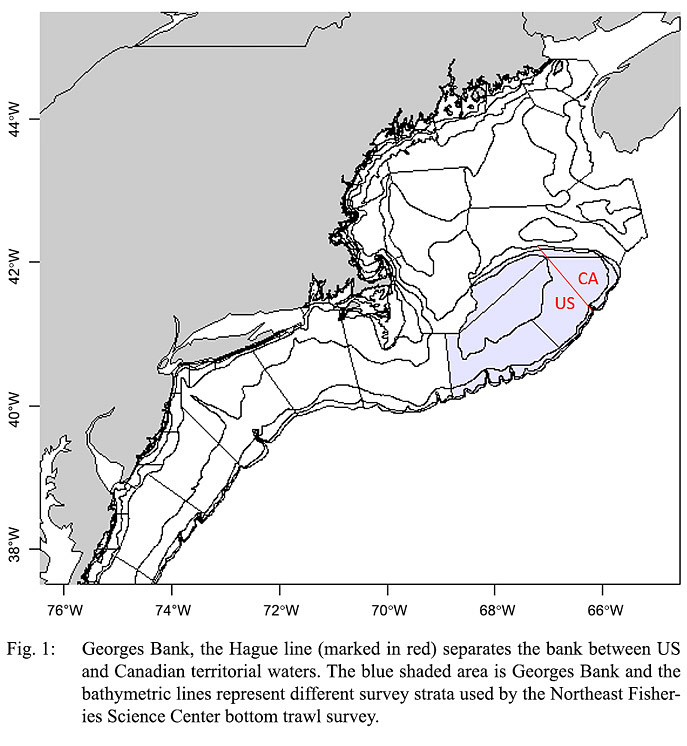
Fig. 1
Stone et al. (2004) documented the collapse of the Georges Bank yellowtail flounder fishery and its subsequent recovery. Their work examined empirical indicators of distribution shifts, age-structure, and trends of exploitation and biomass, demonstrating that the stock was capable of rapid recovery in response to international collaboration and fisheries regulations. However, by the time the paper was published, the stock was already starting to decline again despite continued international collaboration (Stone and Legault, 2005; NEFSC, 2024). In more recent years, stock biomass has been at an all-time low despite these continued regulations and international collaborations. Therefore, reinvestigation of the potential drivers of the Georges Bank yellowtail flounder fishery collapses is needed to understand why bi-lateral science and management did not prevent the second collapse. Understanding drivers of the different collapses can be used to inform management for improved rebuilding plans.
We review available information as well as conduct updated analyses to assess the primary drivers of the initial fishery collapse, subsequent recovery and following collapse of the Georges Bank yellowtail flounder fishery. A historical review of the Georges Bank fishery and stock assessments are provided to understand potential anthropogenic drivers that could cause the different collapses. We also review the most recent stock assessment (NEFSC, 2024) that incorporates process error and environmental covariates, which allows for the direct comparison of fishery and environmental impacts on the population. We conduct new analyses of empirical trends of spatial distribution and growth to determine if these have changed over time. We also use the most recent stock assessment to estimate new projections to see how the stock might change in the future. Results provide valuable information on yellowtail flounder and provide information on the primary drivers of the two different collapses of the yellowtail flounder fishery.
The fishery
A New England fishery for yellowtail flounder developed in the 1930s, coincident with a decline in winter flounder abundance (Royce et al., 1959; Lux, 1964). Yellowtail were caught in otter trawls targeting other groundfish species and scallops. The fishery for yellowtail flounder was historically divided into Southern New England, Georges Bank, and Cape Cod (Lux, 1964). Fishing effort shifted from Southern New England to Georges Bank in the 1940s leading to landings increasing by over 700% by the end of the decade (Royce et al., 1959; Fig. 2). By 1940, New Bedford, Massachusetts had become the principal port for landing flatfishes because of industry infrastructure and proximity to fishing grounds. From 1940–1961 over one-half of all US yellowtail were landed in New Bedford, Massachusetts (Lux, 1964). Landings decreased in the 1950s, possibly from a warming environment (Royce et al., 1959; Lux, 1964; Lux and Nichy, 1969; Sissenwine, 1974).
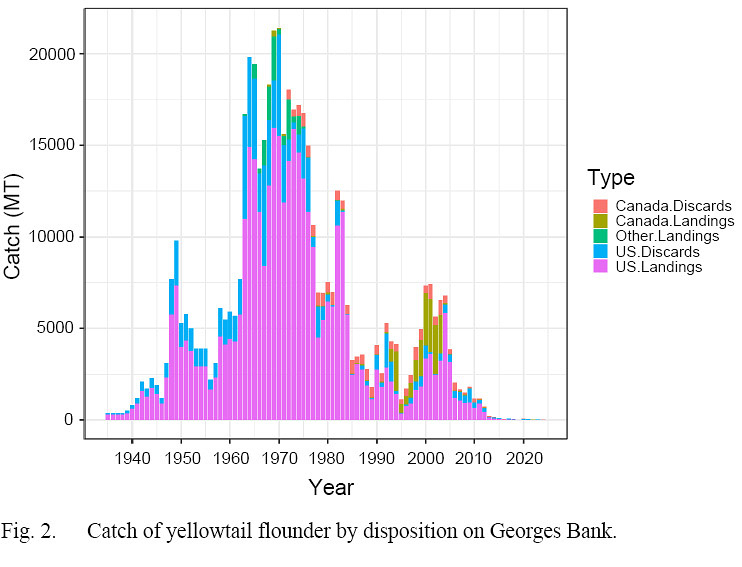
Fig. 2
In the 1960s and early 1970s, distant water fleets targeted Georges Bank groundfish and herring (Fig. 2). During this time fishery removals increased, reaching an all-time high of roughly 21 000 mt in the late 1960s and early 1970s (Fig. 2). Despite regulations developed by the International Commission for the Northwest Atlantic Fisheries (e.g., minimum mesh sizes, minimum fish sizes, spawning closures, annual quotas) decreases in catch were being associated with too much fishing (Kulka, 2012; Brown and Hennemuth, 1971; Sissenwine, 1977).
The US Magnuson-Stevens Act established an exclusive economic zone, excluded distant-water fisheries, and formed regional fishery management councils in 1976. An initial management plan was adopted in 1977 that relied on total allowable catches (TACs), but there was limited enforcement of quotas. Fishing removals decreased somewhat in the early 1980s (Brown et al., 1980; Clark et al., 1981) although misreporting among the stock areas was considered a problem. Increases in mesh size in 1982 and 1983 also contributed to an increase in biomass (McBride and Clark, 1983), but effort was still considered to be too high (Overholtz and Murawski, 1985). In 1984, a maritime boundary was established splitting Georges Bank between the US and Canada. Canada did not have a directed fishery for yellowtail until 1993 (Stone et al., 2004).
Multiple management changes occurred in the 1990s for US and Canada that included limitations on fishing effort (i.e., limited days at sea), increased minimum mesh size regulations, and year-round area closures. A Canadian fishery developed to target yellowtail flounder on eastern Georges Bank in the 1990s, and the US fleet was temporarily allowed access to a closed area to target yellowtail flounder in 2004 (Stone and Legault, 2005). Access to this closed area is a primary reason why fishery catches increased in the early 2000s. However, by 2010 fishery catch started to decline (Fig. 2). Since this decrease, yellowtail has had a limited market and is primarily caught as bycatch in the scallop fishery (NEFSC, 2024). The scallop fishery is the second most lucrative fishery in the region and high catches of yellowtail flounder can lead to accountability measures that closed scallop fisheries in some years (O’Keefe and DeCelles, 2013).
Population assessments
Early stock assessments of Georges Bank yellowtail flounder relied on catch curves, tagging experiments, and a detailed understanding of the fishing fleets operating at the time (Brown et al., 1980). These assessments consistently estimated high fishing mortality rates, relative to natural mortality (M = 0.2), but suggested that fishing had a limited impact on the stock. Early analyses of population dynamics also suggested that temperature could play an important role in stock abundance (Royce et al., 1959; Lux, 1964; Lux and Nichy, 1969). The first analytical stock assessment for Georges Bank yellowtail flounder found high fishing mortality and low stock abundance in the 1980s (NEFSC, 1989). Subsequent assessments found similar results (NEFSC, 1991; NEFSC, 1994), and concluded the stock had collapsed by the mid 1990s (NEFSC, 1994). Canadian catch was first incorporated in the assessment in 1996, but did not change the perception of the stock (Gavaris et al., 1996). The effect of strong management measures (e.g., reduced days-at-sea, increased minimum mesh size, year-round closed areas) were detected by the end of the 1990s by virtual population analysis and surplus production models that both estimated an increase in stock biomass (Cadrin et al., 1999; Stone et al., 2004).
The Transboundary Resources Assessment Committee (TRAC), a joint US-Canadian scientific body, conducted its first joint assessment of Georges Bank yellowtail flounder in 1998 using a virtual population analysis (Neilson and Cadrin, 1998). Retrospective patterns that revised previous stock estimates downward and increased fishing mortality estimates appeared in 2000 (NDWG, 2000) and continued in subsequent assessments (NEFSC, 2002; Stone and Legault, 2003; Legault and Stone, 2004). There were diagnostic problems with the stock assessment in the early 2000s and 2010s with these issues becoming severe in the 2010s. In 2014, the analytical assessment was rejected in favor of an empirical approach that relied on survey trends (O’Brien and Clark, 2014). Catch advice was initially derived from area-swept survey biomass and a target exploitation rate but was revised to a constant quota, conditional on survey biomass remaining within predefined bounds (O’Brien and Clark, 2014). In 2024, a peer review panel supported the recommendation to use a state-space model, the Woods Hole Assessment Model (WHAM, Stock and Miller, 2021), to assess the stock at the conclusion of a multiyear research track assessment (aka benchmark assessment, NEFSC, 2024).
Spatial distribution
A common theory in ecology is that population abundance is positively correlated with spatial range (MacCall, 1990; Holt et al., 1997). As a population decreases, it can contract to preferred habitat (Shackell et al., 2005). Spatial contractions can make it easier for fisheries to target a resource and can violate a common assumption that catch rates are proportional to abundance. Catch rates can stay high or stable in the concentrated areas while population abundance declines (Erisman et al., 2011). Fish can also shift their distribution in response to changing ocean conditions (Nye et al., 2009; Pinsky et al., 2013). We conducted new analyses of the spatial distribution of yellowtail flounder using fisheries independent surveys to examine if spatial distribution changed.
Fisheries surveys are a common tool to explore spatial distributions of marine fishes because they have consistent spatio-temporal sampling. Three fisheries independent surveys cover the entire Georges Bank stock area: Fisheries and Oceans Canada winter survey (DFO, since 1987), and the Northeast Fisheries Science Center (NEFSC) spring and fall surveys (since 1968 and 1963, respectively). All three surveys are based on a stratified random design. The same stratified-mean indices of relative abundance that are derived for stock assessment were used to explore trends in relative abundance. Maps were created to explore visual changes in spatial use. A Gini index (Woillez et al., 2007) was used to measure the spatial distribution for the three different surveys. The Gini index provides a measure of spatial aggregation, with lower values indicate wider distribution and higher values indicate higher concentrations. A Gini index does not provide fine scale measurements of changes in center of gravity or effective area occupied. A loess smoother was fit to the Gini coefficients from each survey to inform long-term trends. The analyses conducted here use a terminal year of 2022, which is the last year in the most recent stock assessment.
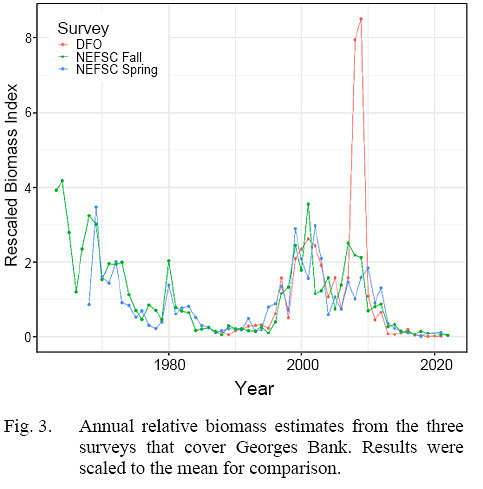
Fig. 3
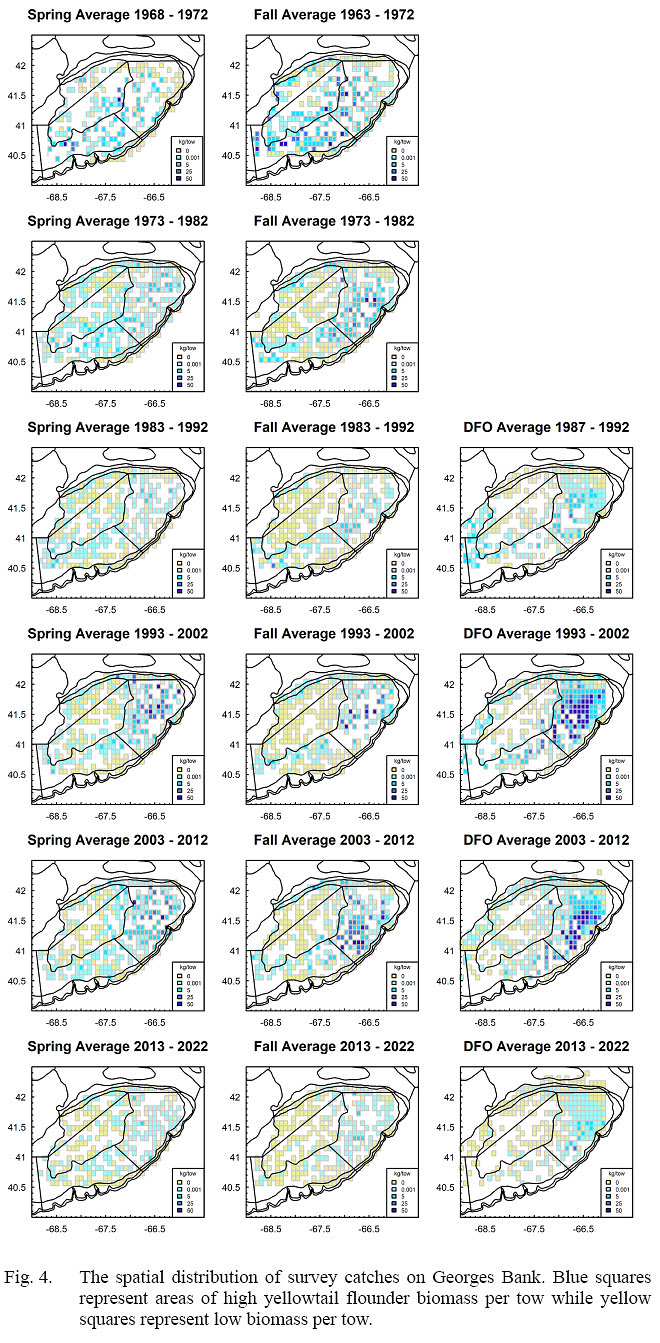
Fig. 4
High catch rates in the fall and spring NEFSC surveys occurred in the 1960s and early 1970s, catch rates were low in all three surveys in the 1980s and early 1990s, catch rates increased from the late 1990s to early 2010s, with high abundance in the southeast portion of Georges Bank. Two high values for the DFO survey in 2008 and 2009 resulted from large catches in single tows creating high uncertainty for these estimates (Figs. 3–4). Catch rates decreased again after 2010 (Figs. 3–4). The loess smoothers of the Gini coefficients shows an increasing trend for all three surveys, indicating the yellowtail flounder are becoming more concentrated in specific habitat on Georges Bank. The loess trend shows an increase in coefficient values for all three surveys until the early 2000s, with the highest Gini coefficients for the NEFSC spring and DFO survey occurring during that time period. However, since the early 2000s the Gini coefficients continue to increase for the NEFSC fall survey and decline for the other two surveys, suggesting seasonal differences in distribution (Fig. 5).
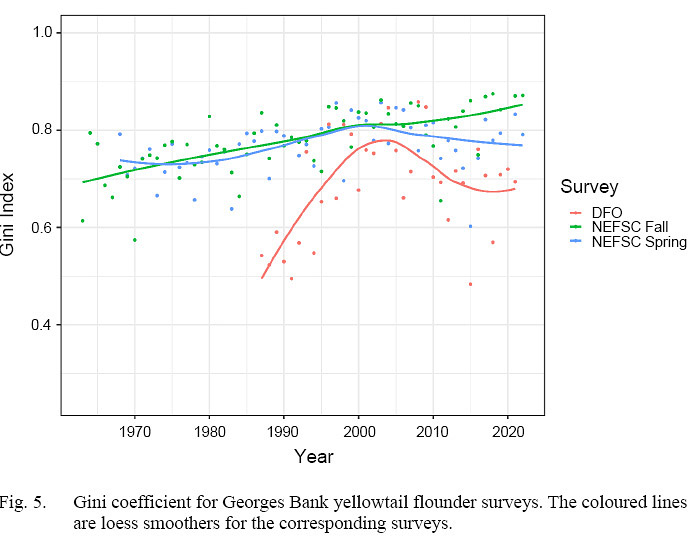
Fig. 5
Size and growth
Size and growth information are important for understanding the population dynamics of a stock and can be used as empirical indicators to inform fisheries management. For example, a lack of smaller fish can indicate reduced recruitment. In contrast, fewer larger fish may indicate slower growth, or higher natural or fishing mortality (Miranda et al., 2024). Empirical length and age data are available for the entire time series for both the NEFSC spring and fall surveys. However, individual weights were not collected on the NEFSC surveys until 1995. Empirical age data is available from the DFO survey since 2004. We produced new analyses of trends in size and growth. These analyses focus on ages one through six, because few fish older than age six were caught in the fisheries and surveys. The stock assessment aggregates these ages into an age-6+ group (NEFSC, 2024). Analyses focused on trends in mean length and mean weight to understand temporal trends in growth. These inputs are commonly used in stock assessment and provide indications about changes in growth.
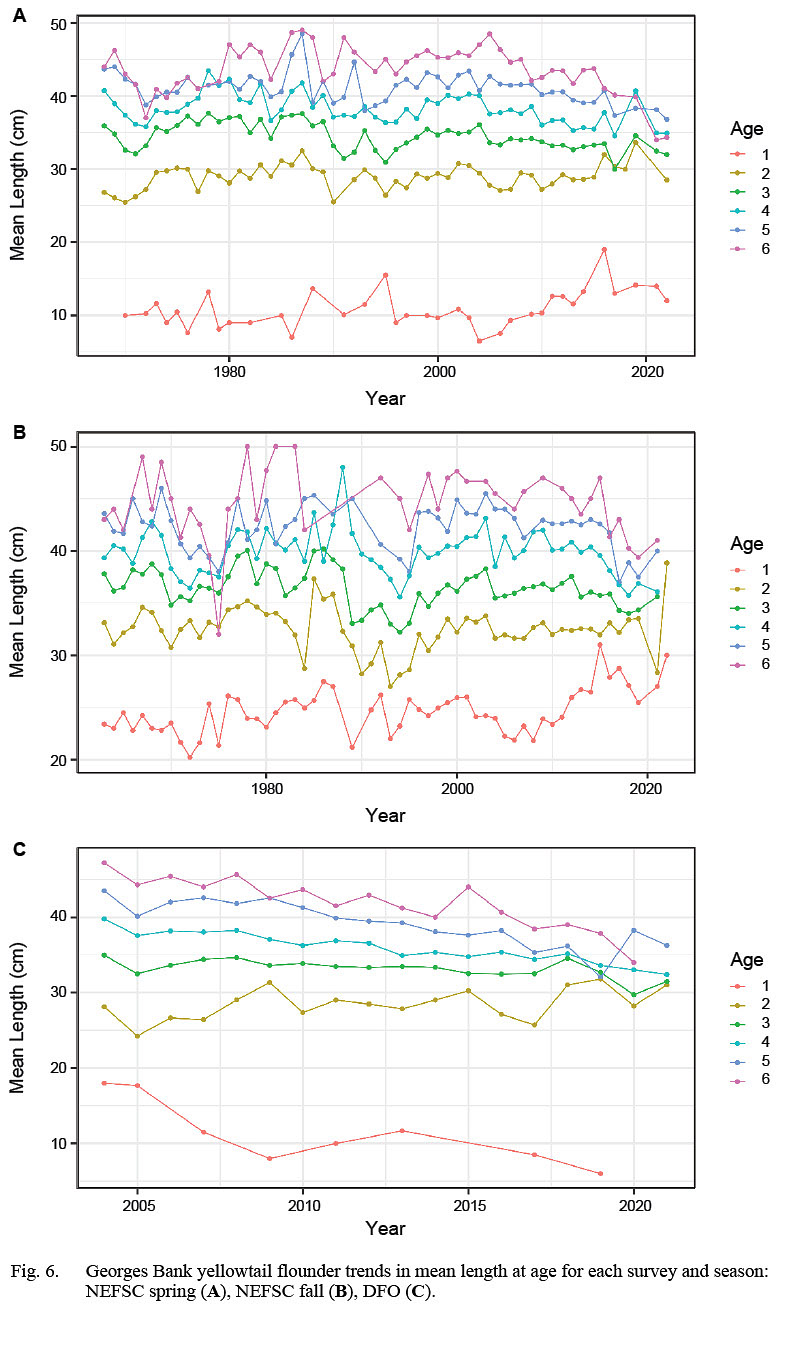
Fig. 6
Mean length at age trends from the NEFSC spring survey suggest older fish were smaller towards the end of the time series (Fig. 6). In the fall survey, mean size at age decreased for most ages in the 1990s followed by an increase. In both seasons, age classes had more overlapping mean size towards the end of the time series compared to the beginning (Figs. 6–7). The DFO time series shows a contraction in mean length with similarities between ages two and age-6+ (Fig. 6). Additionally, no age-one fish were caught since 2019. Trends in mean weight at age show a decreasing trend in weight at age for older fish in the NEFSC spring and DFO surveys. At the end of the time series there is less variability in weight at age between ages from all three surveys (Fig. 7). The number of biological samples are lower in recent years due to reduced catch rates in all three surveys (Fig. 4).
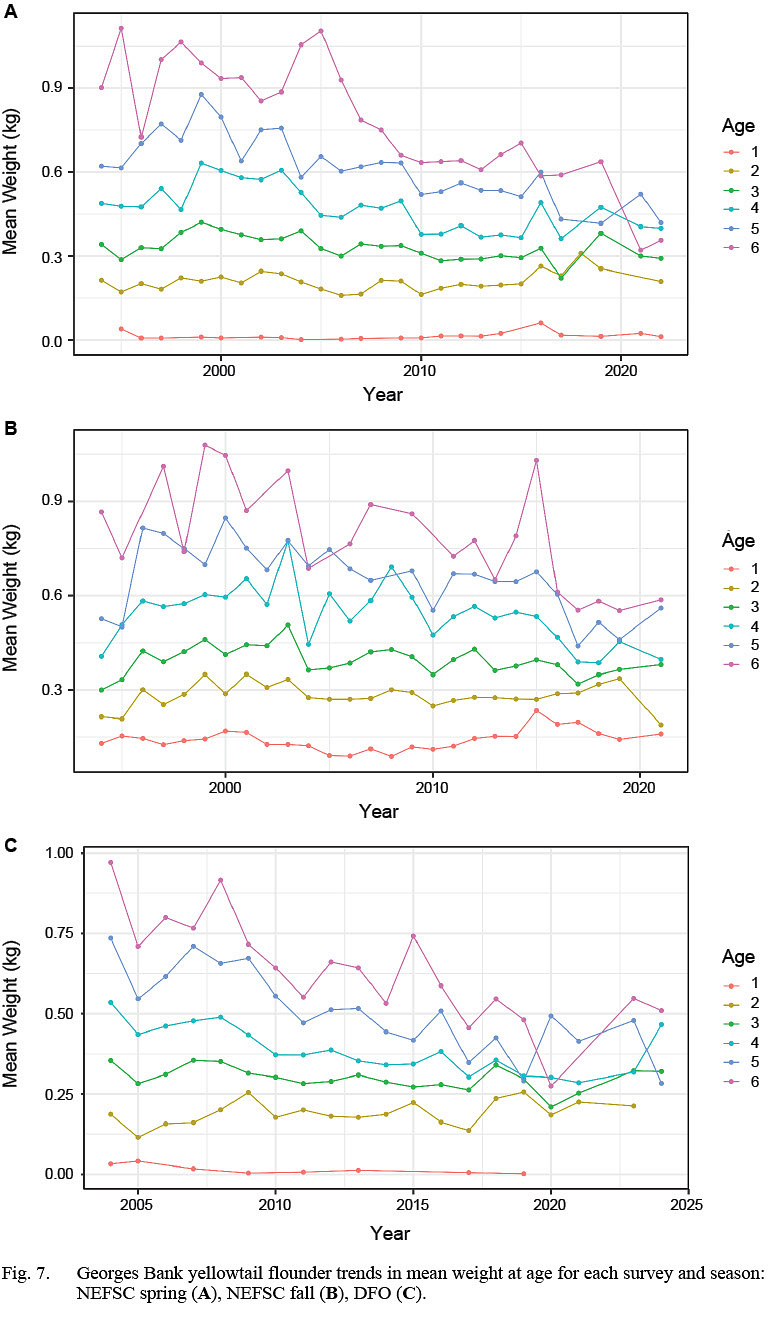
Fig. 7
Temporal trends in the environment, recruitment, biomass, and fishing mortality
We reviewed the most recent stock assessment for Georges Bank yellowtail flounder and used the results to explore temporal trends. The most recent stock assessment applied the Woods Hole Assessment Model (WHAM), which is an age-structured model that allows for the inclusion of environmental variables and process error on different population dynamic processes (Stock and Miller, 2021). The stock assessment time series starts in 1973 with a terminal year of 2022. The assessment performed well with no major diagnostic issues. The model includes time varying selectivity to account for management and targeting changes. The assessment model estimates random effects for abundance at age transitions to account for annual changes in survival. A Beverton-Holt stock recruit relationship was used to model recruitment with changes in the stock recruit parameters informed by a stock specific bottom water temperature time series. This relationship assumes that recruitment is impacted by both stock size and bottom temperature (Supplemental material; NEFSC, 2024).
Environmental trends were thoroughly reviewed during the research track stock assessment using a multi-faceted approach that involved a literature review, exploratory analyses, and exploration within the stock assessment (Kittel et al., 2024; NEFSC, 2024). For Georges Bank yellowtail flounder, this approach hypothesized that water temperature was likely influencing natural mortality or recruitment (Kittel et al., 2024; NEFSC, 2024). An annual time series for Georges Bank was derived from a data product that interpolates monthly bottom temperature at relatively high spatial resolution (Du Pontavice et al., 2023). Stock assessment model diagnostics (e.g., convergence, residuals, Mohn’s rho predictive performance) supported using the bottom temperature covariate to estimate changes in the parameters of the Beverton-Holt stock recruit relationship (NEFSC, 2024). Conversely, model diagnostics did not support including a covariate to estimate time varying natural mortality (Supplemental material; NEFSC, 2024).
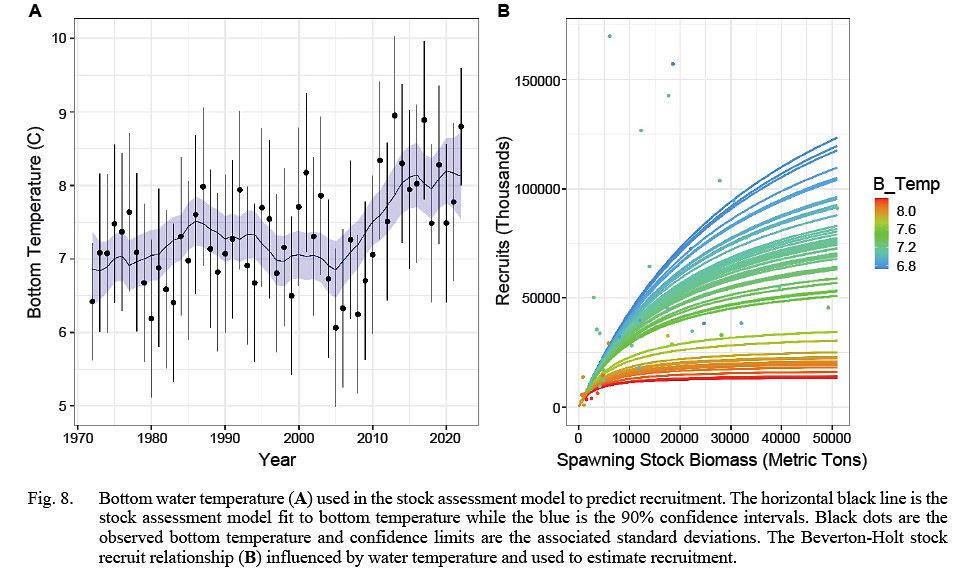
Fig. 8
The stock assessment model fit to the bottom water temperature time series shows that the coldest water temperatures were in the 1970s and early 2000s (Fig. 8). During this same time, recruitment was estimated to be higher (Figs. 8–9). In contrast, bottom water temperature started to warm around 2010 and has been warmest since 2015 (Fig. 8). During this time period, recruitment was estimated to be low (Figs. 8–9).
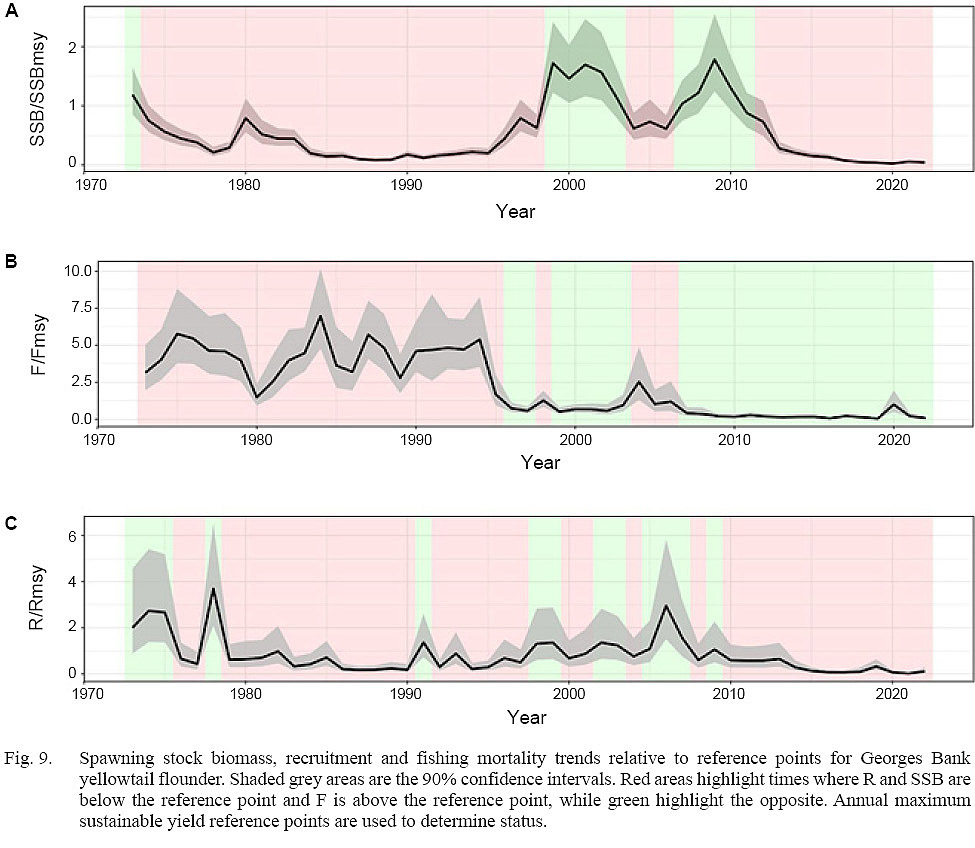
Fig. 9
Annual maximum sustainable yield reference points (SSBmsy, Fmsy, and Rmsy) derived from equilibrium expectations for annual conditions and their relationship to temporal trends in spawning stock biomass, fishing mortality and recruitment show distinct periods of productivity and overexploitation. Spawning stock biomass is estimated to be high and above the reference point at the beginning of the time series followed by decreases in the 1980s and continued low values until the mid 1990s (Fig. 9). In the 1980s and 1990s spawning stock biomass was below the reference point, indicating that the stock was overfished (Fig. 9). Recruitment was high in the 1970s, followed by lower levels of recruitment in the 1980s–1990s, with some productive years (Fig. 9). Fishing mortality was high until the mid 1990s, suggesting that overfishing was occurring during this time. Following this reduction, spawning stock biomass and recruitment increased in the early 2000s when overfishing was no longer occurring. Fishing mortality has remained low since the end of the 1990s, except for a brief increase in the mid 2000s, which is associated with increases in US and Canadian fishing effort. Overfishing has not occurred since the 2004 closed-area access program. By the 2010s, spawning stock biomass and recruitment started to decrease despite reduced fishing effort and catch. Spawning stock biomass, recruitment and fishing effort have remained low since 2010 (Fig. 9).
Future projections
The stock assessment model can be used to project the stock into the future. Short-term projections (3-year) were used to inform future fishing quotas. In this study, we used the stock assessment model to conduct long term projections to explore if the stock could recover in the future. Projection trends were compared to maximum sustainable yield reference points that were calculated based on current environmental conditions. Current conditions of the stock were used in the projection period: weight at age (2-year average), natural mortality (constant), fleet selectivity (with 1st order autoregressive process error), maturity (constant), recruitment and bottom temperature (NEFSC, 2024). Future bottom temperatures were not available but they are needed to inform recruitment in the projection period. Two methods of estimating bottom temperature in the projection period were explored, a 1st order autoregressive process and recent mean. The recent recruitment period was determined using a changepoint analysis and was assumed to be from 2009–2022 (NEFSC, 2024). Under both scenarios the stock was projected 100 years into the future assuming the fishing mortality rate from the last year of the assessment.
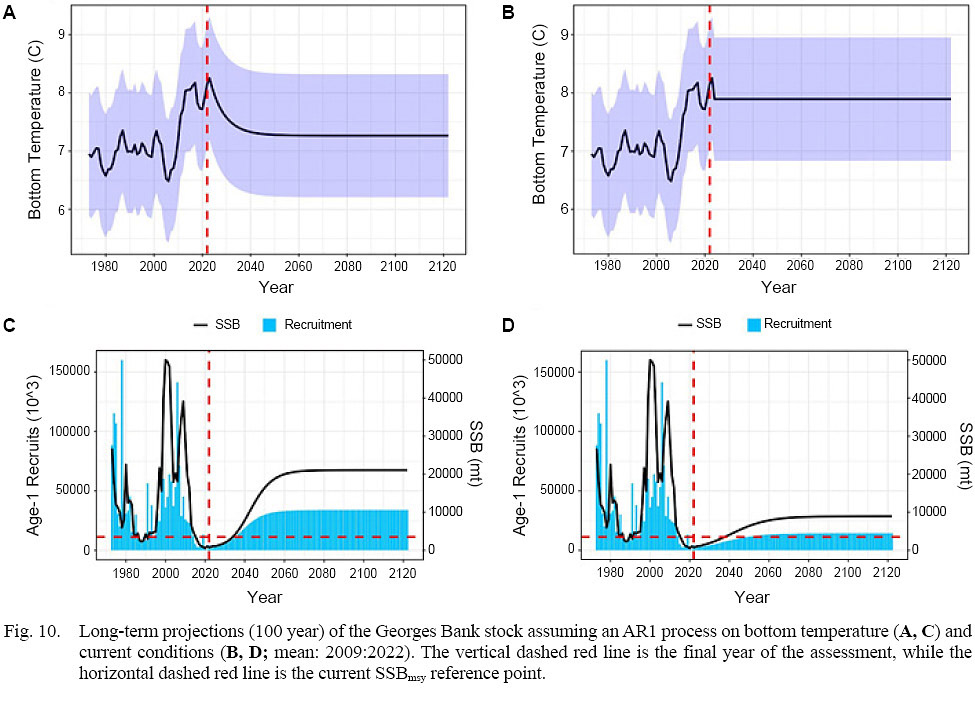
Fig. 10
For the autoregressive process on bottom temperature, bottom temperature slowly cools from the terminal year estimate (2022) to the time series mean. The average bottom temperature from the recent recruitment period estimated warmer bottom water in the projection period. Assuming colder bottom temperatures in the projection period allowed recruitment and biomass to be higher in the projection period (Fig. 10). Under both scenarios, the stock size was able to increase above SSBmsy in the future, suggesting that despite current low population size the stock has the ability to recover under different environmental conditions. However, this recovery is still below historical high estimates from the 1970s and 2000s (Fig. 10). Thus, it is unlikely that Georges Bank yellowtail will support a level of fishery removals that have historically been taken from this stock.
Discussion
A review of biomass trends from the most recent stock assessment suggests biomass was high in the 1970s, followed by decreases in the 1980–90s, with the stock declared collapsed in 1994. Biomass increased in the 2000s with biomass above SSBmsy for large periods of the early 2000s followed by subsequent decreases to all-time lows in the 2020s, indicating the stock had collapsed again. Fishing mortality was high through the mid 1990s followed by a subsequent decrease with some fluctuations through the 2020s.
Stone et al. (2004) hypothesized that the primary driver of stock collapse in the 1990s was overfishing, and subsequent recovery in the early 2000s was due to effective bi-lateral science and coordinated management. The results presented here support those hypotheses with the most recent assessment estimating a sharp decline in fishing mortality in the mid 1990s. These reductions are likely due to the implementation of TACs, closed areas, decreased days-at-sea, and increases in mesh size (Stone et al., 2004). The implementation of bi-lateral science and precautionary management during this time also likely benefited the stock and fishery. Subsequent decreases since 2010 are likely due to different factors because similar management measures remain. Thus, it is unlikely that fishing is the primary driver of stock dynamics in recent years (Fig. 9).
Over the last several decades, variability in ocean conditions have been well documented on Georges Bank, with observed changes in salinity, temperature, and predator/prey abundance (Wallace et al., 2018; Tsou and Collie, 2001; Mountain and Kane, 2010). Changing environmental conditions were suggested to have possibly led to reduced recruitment of Georges Bank yellowtail flounder in the 1980s and early 1990s (Stone et al., 2004). A review of the stock assessment model suggests that bottom water temperature impacts recruitment (Fig. 8). Estimated water temperatures from the stock assessment suggest slightly colder water temperatures in the 1970s, warmer temperatures in the 1980/1990s followed by colder temperatures in the 2000s. These fluctuations in cold water temperature coincide with periods of improved recruitment and subsequent larger stock size (Figs. 8–9). Additionally, warmer temperatures since 2010 are the primary reason stock size remains low despite low fishing mortality (Figs. 8–9).
Temperature can impact multiple aspects of recruitment including timing, egg viability, food availability, larval growth and mortality (Takade-Heumacher et. al., 2014). It is unclear what the specific mechanism is for Georges Bank yellowtail flounder. However, it has long been hypothesized that warm temperatures could lead to reduced recruitment (Royce et al., 1959; Lux, 1964; Lux and Nichy, 1969). Previous research, has linked recruitment deviations to water temperature for yellowtail founder on Georges Bank (Brodziak and OʼBrien, 2005; Takade-Heumacher et al., 2014) and the adjacent stock in southern New England (Sissenwine, 1974, 1977; Sullivan et al., 2005).
For yellowtail flounder, the majority of research exploring changing ocean conditions have focused on the Southern New England stock. This population is thought to be most susceptible because it is at the Southern extent of the species range (Hare et al., 2016). Unlike the Georges Bank stock, abundance of the Southern New England stock has been decreasing since the 1980s with no signs of recovery (NEFSC, 2024). Previous research applications of the stock assessment have used a cold pool index to improve recruitment estimation, which measures the spatial extent and persistence of cold bottom water across the mid-Atlantic bight (Miller et al., 2016; Xu et al., 2017). The most recent stock assessment currently uses the Gulf Stream index to estimate deviations in recruitment, which measures the latitude above average of the Gulf Stream position (NEFSC, 2024). The Gulf of Maine/Cape Cod stock is the northernmost yellowtail flounder stock in the US and no environmental indicators are currently included in the stock assessment. However, it is hypothesized that fish might be shifting deeper in this region to account for changes in water temperature (Nye et al., 2009).
On Georges Bank, new analyses of spatial distribution suggest that yellowtail flounder were most widely distributed in the 1970s, which corresponds to a period of high stock size (Figs. 4,5,9). However, since then there has been a steady contraction in spatial range (Fig. 4). During the periods of highest stock size in the 2000s, the DFO and to a lesser extent the spring NEFSC survey suggest that there was a restriction in spatial use, with fish occupying less habitat (Figs. 4, 5). Large spatial contractions like this can make the population especially vulnerable to fishing, but fishing mortality rates were not high at these times (Erisman et al., 2011, Fig. 9). The “Basin Hypothesis” has been suggested for yellowtail flounder on the Grand Bank and Georges Bank (Pereria et al., 2012; Adams et al., 2018), which theorizes that when population abundance is high yellowtail occupy a wide range of habitats (MacCall, 1990). The Gini coefficients provide a measure of spatial dispersion; however, the results vary among the seasonal surveys. The Gini coefficients suggest that in the fall NEFSC survey yellowtail flounder are occupying less habitat at lower population sizes. The opposite trend occurs in the spring with the NEFSC and DFO surveys estimating fish are occupying less habitat at larger population sizes in the early 2000s (Fig. 5). It is possible that these differences could be due to seasonal environmental conditions, especially because the Spring NEFSC and DFO sample at a similar time of year. Additionally, differences could be due to changes in size structure between the different surveys. The conflict in results, and the use of a single spatial metric, prevent confirmation of the “Basin Hypothesis”. Future research should consider additional spatial metrics (e.g., center of gravity, Moran, 1950) and could look to link environmental covariates to dispersion metrics.
Thermal preferences could be altering the spatial use of yellowtail flounder on Georges Bank. The optimal temperature for yellowtail flounder on Georges Bank is hypothesized to be roughly 7°C (Hyun et al., 2014). Since 2009, the average bottom water temperature on Georges Bank has been warmer than 7°C (Fig. 8). This suggests future work should consider exploring time varying availability and spatial distribution shifts of yellowtail flounder. Spatial shifts could be incorporated into future stock assessments with time varying catchability and/or selectivity parameters or the use of spatio-temporal models to standardize survey data (Wilberg et al., 2009; Cao et al., 2017).
Length data from the NEFSC spring and fall survey cover the periods of high stock size (1970s and 2000s) and low stock size (1990s and 2010s). Mean length tended to be larger when the stock was larger and smaller when the stock was lower. Additionally at lower stock biomass, mean length at age one is more similar to mean length at age two (Fig. 6). All length and weight information indicates that fish have been shorter and lighter than they were historically and there is more overlap in size among adjacent ages, indicating reduced growth (Figs. 6–7). Observed changes in size at age could be the result of environmental factors, such as changes in water temperature or prey composition. Future work should explore potential drivers of observed changes in size.
Growth is an important component of stock productivity because natural mortality and reproductive potential usually scale with size. Fish that are larger are less likely to be eaten and produce more offspring (Miranda, et al., 2024). Typically, fishing gear releases small fish and retains larger fish, which can influence the size structure of the population (Enberg et al., 2012). The environment can also influence growth, with restrictions in thermal range possibly negatively affecting growth (Boltaña et al., 2017). Reduced growth, low stock size and reduced fishing at the end of the time series suggest that density dependent factors are not influencing growth for Georges Bank yellowtail.
New long-term projections from this study suggest that the Georges Bank yellowtail flounder stock can increase again in the future. The rate and extent of increase will be based on biology, fishing mortality and bottom temperature. Based on the current assessment, colder bottom temperatures will allow the stock to increase faster and support larger stock sizes. More work is needed on how to treat bottom water temperature in the projection period. Especially since short term projections are often used to inform fisheries management. For example, it is probably not appropriate to assume the most recent conditions (2009–2022) will hold in the future. Additionally, the autocorrelated temperature projection allows the first several years in the projection period to be correlated with terminal year estimates of bottom temperature. This might be appropriate for short-term projections, but over the long-term bottom temperature reverts back to the mean of the entire time series. For long term predictions, neither approach is realistic given the dynamic nature of Georges Bank and predictions of future ocean conditions (Wallace et al., 2018; Cheng et al., 2022). WHAM can fit to future estimates of a covariate in the projection period, but this information is not available for the bottom temperature time series used in the assessment (Du Pontavice et al., 2023). Thus, future work should explore using climate projections in the stock assessment projection period.
Several take home lessons can be learned from the collapses of the Georges Bank yellowtail fishery. Lesson 1: Overfishing can drive a fishery collapse but international collaboration and strong management can drive a recovery. This is observed by the fishery collapse in 1994 being driven by overfishing and the subsequent international collaborations on stock assessment (e.g., TRAC) and strong fishery management measures (e.g., days at sea, changes in mesh size) rebuilding the stock in the early 2000s. Lesson 2: Changing environment conditions can override effective management. Despite continued international collaboration and effective management still being in place the stock collapsed again in 2010. A review of the most recent stock assessment suggests that the second collapse was due to warming water temperatures. Lesson 3: The importance of exploring environmental data in stock assessment. Advances in stock assessment modeling (e.g., WHAM) allowed for the direct incorporation of environmental variables to determine mechanistic links of the different collapses. Being able to include environmental variables directly into the stock assessment makes it easier to communicate results to stakeholders and managers. Thus, we recommend other stock assessments explore environmental drivers on population dynamic processes. Lesson 4: Stock recovery can still occur under current environmental conditions but the stock will not be able to support historic levels of fishing. Scientists and managers need to adapt expectations (e.g., biological reference points) to account for these changes. Ultimately, the collapses of Georges Bank yellowtail flounder serve as a valuable case study, highlighting that fishery collapses can be caused by different factors and the importance of understanding the impact of fishing as well as a changing environment.
Acknowledgements
We thank the scientists who contributed to previous yellowtail flounder stock assessments, the Yellowtail Flounder Research Track working group and the Research Track peer review panel for helping to improve the stock assessment. We also appreciate feedback from the editor and the two anonymous reviewers. The scientific conclusions, views or opinions expressed are those of the authors and do not necessarily reflect the views of our affiliated organizations.
References
Adams, C. F., Brooks, E. N., Legault, C. M., Barrett, M. A., and Chevrier, D. F. 2021. Quota allocation for stocks that span multiple management zones: analysis with a vector autoregressive spatiotemporal model. Fisheries Management and Ecology, 28(5), 417–427. https://doi.org/10.1111/fme.12488
Boltaña, S., Sanhueza, N., Aguilar, A., Gallardo‐Escarate, C., Arriagada, G., Valdes, J. A., and Quiñones, R. A. 2017. Influences of thermal environment on fish growth. Ecology and evolution, 7(17), 6814–6825. https://doi.org/10.1002/ece3.3239
Brodziak, J., and O’Brien, L. 2005. Do environmental factors affect recruits per spawner anomalies of New England groundfish? ICES Journal of Marine Science, 62, 1394–1407. https://doi.org/10.1016/j.icesjms.2005.04.019
Brown, B. E. and Hennemuth, R. C. 1971. Prediction of yellowtail flounder population size from pre-recruit catches. International Commission for the Northwest Atlantic Fisheries Research Document 71/115. 8 p.
Brown, B. E., Sissenwine, M. P., and McBride. M. M. 1980. Implications of Yellowtail Flounder stock assessment information for management strategies. Woods Hole Laboratory Reference No. 80–21. 12 p.
Cadrin, S. X., King, J., and Suslowicz, L. 1999. Status of the Cape Cod yellowtail flounder stock for 1998. NEFSC Ref. Doc.. 99–04. https://repository.library.noaa.gov/view/noaa/5127
Cao, J., Thorson, J. T., Richards, R. A., and Chen, Y. 2017. Spatiotemporal index standardization improves the stock assessment of northern shrimp in the Gulf of Maine. Canadian Journal of Fisheries and Aquatic Sciences, 74(11), 1781–1793. https://doi.org/10.1139/cjfas-2016-0137
Cheng, L., von Schuckmann, K., Abraham, J. P., Trenberth, K. E., Mann, M. E., Zanna, L., and Lin, X. 2022. Past and future ocean warming. Nature Reviews Earth & Environment, 3(11), 776–794. https://doi.org/10.1038/s43017-022-00345-1
Clark, S. H., O’Brien, L., and Mayo, R. K. 1981. Yellowtail Flounder stock status – 1981. Woods Hole Laboratory Reference Document No. 81–10. 47 p.
Du Pontavice, H., Chen, Z., and Saba, V. S. 2023. A high-resolution ocean bottom temperature product for the northeast US continental shelf marine ecosystem. Progress in Oceanography, 210, 102948. https://doi.org/10.1016/j.pocean.2022.102948
Enberg, K., Jørgensen, C., Dunlop, E. S., Varpe, Ø., Boukal, D. S., Baulier, L., and Heino, M. 2012. Fishing‐induced evolution of growth: Concepts, mechanisms and the empirical evidence. Marine ecology, 33(1), 1–25. https://doi.org/10.1111/j.1439-0485.2011.00460.x
Erisman, B. E., Allen, L. G., Claisse, J. T., Pondella, D. J., Miller, E. F., and Murray, J. H. 2011. The illusion of plenty: hyperstability masks collapses in two recreational fisheries that target fish spawning aggregations. Canadian Journal of Fisheries and Aquatic Sciences, 68(10), 1705–1716. https://doi.org/10.1139/f2011-090
Fogarty, M. J., and Murawski, S. A. 1998. Large‐scale disturbance and the structure of marine systems: fishery impacts on Georges Bank. Ecological Applications, 8(sp1), S6–S22.https://doi.org/10.1890/1051-0761(1998)8[S6:LDATSO]2.0.CO;2
Gavaris, S., Hunt, J. J., Neilson, J. D., and Page, F. 1996. Assessment of Georges Bank Yellowtail Flounder. DFO Atlantic Fisheries Res. Doc. 96/22.
Glenn, R. P., and Pugh, T. L. 2006. Epizootic shell disease in American lobster (Homarus americanus) in Massachusetts coastal waters: interactions of temperature, maturity, and intermolt duration. Journal of Crustacean Biology, 26(4), 639–645. https://doi.org/10.1651/S-2754.1
Hare J. A., Morrison W. E., Nelson M. W., Stachura M. M., Teeters E. J., Griffis R. B., Alexander M. A., Scott J. D., Alade L., Bell R. J., and Chute A. S. 2016. A vulnerability assessment of fish and invertebrates to climate change on the northeast US continental shelf. PLoS ONE 11(2): e0146756. https://doi.org/10.1371/journal.pone.0146756
Holt, R. D., Lawton, J. H., Gaston, K. J., and Blackburn, T. M. 1997. On the relationship between range size and local abundance: back to basics. Oikos, 183–190. https://doi.org/10.2307/3545815
Hutchings, J. A., and Myers, R. A. 1994. What can be learned from the collapse of a renewable resource? Atlantic cod, Gadus morhua, of Newfoundland and Labrador. Canadian Journal of Fisheries and Aquatic Sciences, 51(9), 2126–2146. https://doi.org/10.1139/f94-214
Hyun, S. Y., Cadrin, S. X., and Roman, S. 2014. Fixed and mixed effect models for fishery data on depth distribution of Georges Bank yellowtail flounder. Fisheries research, 157, 180–186. https://doi.org/10.1016/j.fishres.2014.04.010
Jacobson, L. D., and MacCall, A. D. 1995. Stock-recruitment models for Pacific sardine (Sardinops sagax). Canadian Journal of Fisheries and Aquatic Sciences, 52(3), 566–577. https://doi.org/10.1139/f95-057
Kulka D. W. 2012. History and Description of the International Commission for the Northwest Atlantic Fisheries. https://www.nafo.int/Portals/0/PDFs/icnaf/ICNAF_history-kulka.pdf.
Legault, C. M., and H. H. Stone. 2004. Stock assessment of Georges Bank Yellowtail Flounder (5Zhjmn) Yellowtail Flounder for 2004. Transboundary Resources Assessment Committee Reference Document 2004/03. 102 p.
Lux, F. E. 1964. Landings. fishing effort, and apparent abundance in the yellowtail flounder fishery. ICNAF Res. Bull. 1, 5–21.
Lux, F. E., and Nichy, F. E. 1969. Growth of yellowtail flounder, Limanda ferruginea (Storer), on three New England fishing grounds. ICNAF Res. Bull. No. 6., 5–25.
MacCall A. D. 1990. Dynamic Geography of Marine Fish Populations. University of Washington Press.
McBride, M. M., and Clark, S. H.. 1983. Assessment status of yellowtail flounder (Limanda ferruginea) stocks off the northeastern United States. NEFC Lab. Ref. Doc., 83–32.
Miller, T. J., Hare, J. A., and Alade, L. A.. 2016. A state-space approach to incorporating environmental effects on recruitment in an age-structured assessment model with an application to southern New England yellowtail flounder. Canadian Journal of Fisheries and Aquatic Sciences. 73(8): 1261–1270. https://doi.org/10.1139/cjfas-2015-0339
Miranda, L. E., Funk, H. G., Palmieri, M., Stafford, J. D., and Nichols, M. E. 2024. Length in assessing status of freshwater fish populations: A review. North American Journal of Fisheries Management, 44(5), 1092–1110. https://doi.org/10.1002/nafm.11041
Mountain, D. G., and Kane, J. 2010. Major changes in the Georges Bank ecosystem, 1980s to the 1990s. Marine Ecology Progress Series, 398, 81–91. https://doi.org/10.3354/meps08323
Mullon, C., Fréon, P., and Cury, P. 2005. The dynamics of collapse in world fisheries. Fish and fisheries, 6(2), 111–120. https://doi.org/10.1111/j.1467-2979.2005.00181.x
Moran, P. A. P. 1950. Notes on Continuous Stochastic Phenomena. Biometrika, 37(1), 17–23. https://doi.org/10.1093/biomet/37.1-2.17; https://doi.org/10.2307/2332142
[NEFSC] Northeast Fisheries Science Center. 1989. Report of the Seventh NEFSC Stock Assessment Workshop (SAW). Northeast Fisheries Science Center Reference Document 89–04. 113 p. https://repository.library.noaa.gov/view/noaa/5108
[NEFSC] Northeast Fisheries Science Center. 1991. Report of the Twelfth Northeast Regional Stock Assessment Workshop (SAW). Northeast Fisheries Science Center Reference Document 91–03. 188 p. https://repository.library.noaa.gov/view/noaa/9029
[NEFSC] Northeast Fisheries Science Center. 1994. Report of the 18th Northeast Regional Stock Assessment Workshop (18th SAW). Northeast Fisheries Science Center Reference Document 94–23. 71 p. https://repository.library.noaa.gov/view/noaa/5104
[NEFSC] Northeast Fisheries Science Center. 2002. Assessment of 20 Northeast groundfish stocks through 2001: a report of the Groundfish Assessment Review Meeting (GARM), Northeast Fisheries Science Center, Woods Hole, Massachusetts, October 8–11, 2002. NEFSC Ref. Doc. 02–16. https://repository.library.noaa.gov/view/noaa/5344
[NEFSC] Northeast Fisheries Science Center. 2024. Research Track Stock Assessment Report for Yellowtail Flounder.
Neilson, J. D. and Cadrin, S. X. 1998. 1998 assessment of Georges Bank (5Zjmnh) Yellowtail Flounder. Canadian Stock Assessment Secretariat Research Document 98/67. 90 p.
Nye, J. A, Link, J. S., Hare, J. A., Overholtz, W. J. 2009. Changing spatial distribution of fish stocks in relation to climate and population size on the Northeast United States continental shelf. Marine Ecology Progress Series, 393, 111–129. https://doi.org/10.3354/meps08220
[NDWG] Northern Demersal Working Group. 2000. Assessment of 11 Northeast groundfish stocks through 1999: a report to the New England Fishery Management Council’s Multi-Species Monitoring Committee. Northeast Fisheries Science Center Reference Document, 00–05. 175 p.
O’Brien, L., and Clark, K. 2014. Proceedings of the Transboundary Resources Assessment Committee for Georges Bank Yellowtail Flounder Diagnostic and Empirical Approach Benchmark. TRAC Proceedings Doc. 2014/01. https://repository.library.noaa.gov/view/noaa/26476
O’Keefe, C. E., and DeCelles, G. R. 2013. Forming a Partnership to Avoid Bycatch. Fisheries 38(10), 434–444. https://doi.org/10.1080/03632415.2013.838122
Overholtz, W. J., and S. A. Murawski. 1985. A preliminary assessment of the Georges Bank multispecies trawl-fisheries with special reference to haddock and Yellowtail Flounder. Woods Hole Laboratory Reference Document No. 85–08. 51 p.
Pauly, D., Watson, R., and Alder, J. 2005. Global trends in world fisheries: impacts on marine ecosystems and food security. Philosophical Transactions of the Royal Society B: Biological Sciences, 360(1453), 5–12. https://doi.org/10.1098/rstb.2004.1574
Pauly, D., and Tsukayama, I. 1987. The Peruvian anchoveta and its upwelling ecosystem: three decades of change (Vol. ١٥). WorldFish.
Pereira, J. J., Schultz, E. T., and Auster, P. J. 2012. Geospatial analysis of habitat use in yellowtail flounder Limanda ferruginea on Georges Bank. Marine Ecology Progress Series, 468, 279–290. https://doi.org/10.3354/meps10035
Pinsky, M. L., Worm, B., Fogarty, M. J., Sarmiento, J. L., and Levin, S. A. 2013. Marine taxa track local climate velocities. Science, 341(6151), 1239–1242. https://doi.org/10.1126/science.1239352
Roughgarden, J., and Smith, F. 1996. Why fisheries collapse and what to do about it. Proceedings of the National Academy of Sciences, 93(10), 5078–5083. https://doi.org/10.1073/pnas.93.10.5078
Royce, W. F., Buller, R. J., and Premetz, E. D. 1959. Decline of the yellowtail flounder fishery. ICNAF Res. Doc. 59/31 pp.
Shackell, N. L., Frank, K. T., and Brickman, D. W. 2005. Range contraction may not always predict core areas: an example from marine fish, Ecological Applications, 15(4), 1440–1449. https://doi.org/10.1890/04-0642
Sissenwine, M. P. 1974. Variability in recruitment and equilibrium catch of the Southern New England yellowtail flounder fishery. J. Cons. Int. Explor. Mer., 36, 15–26. https://doi.org/10.1093/icesjms/36.1.15
Sissenwine, M. P. 1977. A compartmentalized simulation model of the Southern New England Yellowtail Flounder, Limanda ferruginea, fishery. Fishery Bulletin, 75, 465–482.
Stock, B. C., and Miller, T. J. 2021. The Woods Hole Assessment Model (WHAM): a general state-space assessment framework that incorporates time-and age-varying processes via random effects and links to environmental covariates. Fisheries Research, 240, 105967. https://doi.org/10.1016/j.fishres.2021.105967
Stone, H. H., and Legault, C. M. 2003. Stock assessment of Georges Bank (5Zhjmn) Yellowtail Flounder for 2003. Canadian Science Advisory Secretariat Research Document 2003/055. 80 p.
Stone, H. H., and Legault, C. M. 2005. Stock assessment of Georges Bank (5Zhjmn) Yellowtail Flounder for 2005. TRAC Research Document 2005/04. 83 p.
Stone, H. H., Gavaris, S., Legault, C. M., Neilson, J. D., and Cadrin, S. X. 2004. Collapse and recovery of the yellowtail flounder (Limanda ferruginea) fishery on Georges Bank. Journal of Sea Research, 51(3–4), 261–270.
Sullivan, M. C., Cowen, R. K., Steves, B. P. 2005. Evidence for atmosphere–ocean forcing of yellowtail flounder (Limanda ferruginea) recruitment in the Middle Atlantic Bight. Fisheries Oceanography, 14, 386–399. https://doi.org/10.1111/j.1365-2419.2005.00343.x
Takade-Heumacher, H., Liu, O., Smith, S. L., Kritzer, J., Fujita, R., and Fund, E. D. 2014. Exploring hypotheses for reduced growth and truncated size structure of Georges Bank yellowtail flounder. TRAC Working Paper, 2014/44.
Tsou, T. S., and Collie, J. S. 2001. Estimating predation mortality in the Georges Bank fish community. Canadian Journal of Fisheries and Aquatic Sciences, 58(5), 908–922. https://doi.org/10.1139/f01-044
Wainright, S. C., Fogarty, M. J., Greenfield, R. C., and Fry, B. 1993. Long-term changes in the Georges Bank food web: trends in stable isotopic compositions of fish scales. Marine Biology, 115, 481–493. https://doi.org/10.1007/BF00349847
Wallace, E. J., Looney, L. B., and Gong, D. 2018. Multi-decadal trends and variability in temperature and salinity in the Mid-Atlantic Bight, Georges Bank, and Gulf of Maine. Journal of Marine Research, 76, 163.
Wilberg, M. J., Thorson, J. T., Linton, B. C., and Berkson, J. I. M. 2009. Incorporating time-varying catchability into population dynamic stock assessment models. Reviews in Fisheries Science, 18(1), 7–24. https://doi.org/10.1080/10641260903294647
Woillez, M., Poulard, J-C., Rivoirard, J., Petitgas, P., and Bez, N. 2007. Indices for capturing spatial patterns and their evolution in time, with application to European hake (Merluccius merluccius) in the Bay of Biscay. ICES Journal of Marine Science, 64: 537–550. https://doi.org/10.1093/icesjms/fsm025
Xu, H., Miller, T. J., Hameed, S., Alade, A. L., and Nye, J. 2017. Evaluating the Utility of the Gulf Stream Index for Predicting Recruitment of Southern New England-Mid Atlantic yellowtail flounder. Fisheries Oceanography, 27, 85–95. https://doi.org/10.1111/fog.12236